Making of
How deep it goes
No one handed us a Junk Yard. There were photos, a service manual, a patent, some rulesheets and the machine's own program. This is how far we went to rebuild something nearly identical to the original.
Made by a fan@scheemunai
One fan directed a team of AI agents through the research and the rebuild, and checked every step against the real machine: its photos, its manual, and in the end its own program. Where AI tools helped with the art and the toys, they worked from photos of real machines, and the results were measured against them.
Chapter 01
Research: the machine on paper
Before a single ball rolled, the machine had to be known better than most owners know it.
- Every photo. All 76 photos on the Internet Pinball Database's Junk Yard page were reviewed, through the Internet Archive (only two, the Magic Bus and Spike's house, are archived nowhere, and other photos cover both). 38 were kept for layout, proportions and how the toys work, plus 13 factory diagrams.
- The manual, all 146 pages, and the 16-page operators handbook: the rules, the story, every mechanism drawing, and the full wiring.
- The patent. Williams' 1997 patent on the wrecking ball (US 5,833,236) explains the crane exactly: five cars on a raised base that only the swinging ball can reach, and a lane right behind it that the ball partly blocks.
- The rules, from the manual, the 1997 Williams website, the original 1997 rulesheets and the licensed digital version.
- Conflicts, resolved and recorded. When sources disagree (is the multiball two balls or three? which ramp collects Window Shopping? does the extra ball light at the third piece of junk or the fifth?), the research notes both sides and the choice.
- The wiring. Every switch, lamp and coil is numbered as on the real machine, so the software can talk to the table the way the real boards do.
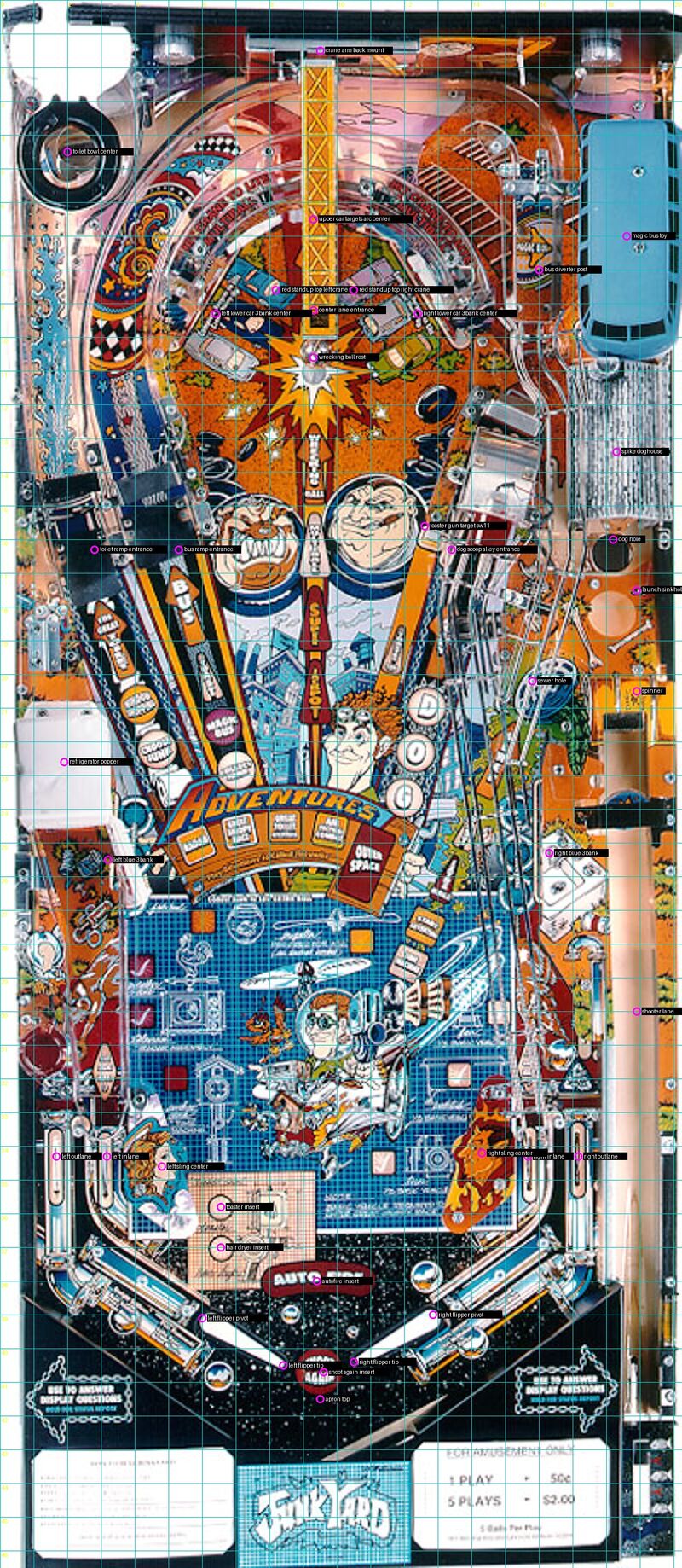
Then the measuring: the straightened photo laid over Williams' official scan, and 40 features, from the flipper pivots to the sewer, measured in inches. The whole table is built on those numbers.
Chapter 02
The machine's brain
First, a reconstruction
A pinball machine's rules live in its program. At first we left the original program alone and rebuilt the rules by hand, feature by feature, from the manual and the rulesheets. Every value was graded by where it came from:
| Source of the rule value | Values |
|---|---|
| Official Williams material | 23 |
| Several sources that agree | 8 |
| A single community source | 34 |
| Our estimate | 20 |
A fresh tester then played it against the research, not against our notes: 66 full games, about seven hours of simulated play, without a single error or lost ball. Every major feature was there and paid what the sources say.
It was faithful. But faithful isn't identical: 54 of those 85 values rested on one community source or a guess, and the display art, the voices and the music were our own. Only the real program could close that gap.
Then, the real thing
So the original 1996 program came back. Junk Yard's game software (version 1.2) runs on a 6809 processor on a WPC-95 board; its sound runs on a separate board with its own signal processor. Both are emulated, and they run in the browser.
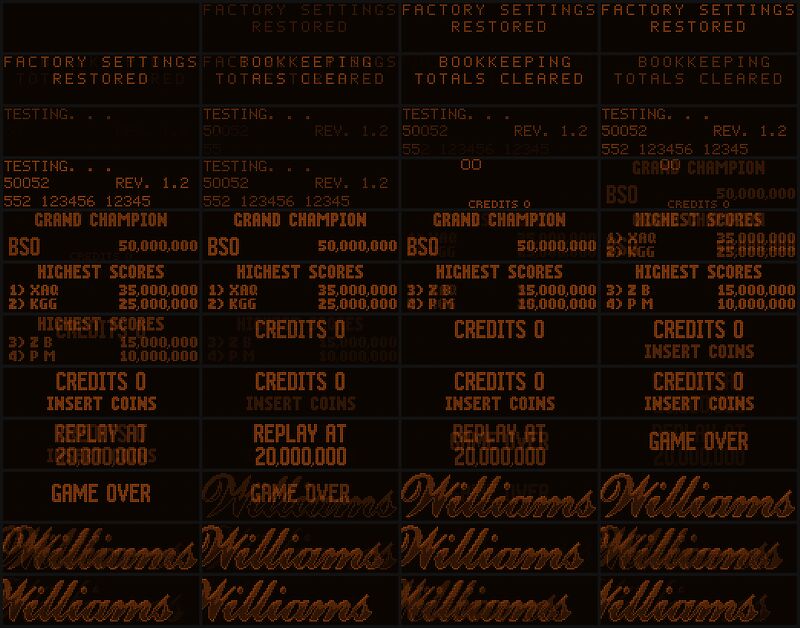
The proof that it fits our table is the program's own service menu. Its switch test named every switch we closed; its coil test fired our coils in the manual's order; its single-lamp test lit our lamps one by one. 57 switches, 12 coils and 64 lamps: every number matched.
In the game, the 1996 program runs the rules, the scoring, the display and the sound, on our table and our physics. It runs on its own thread in the background; the flippers move on the very next physics step and the program confirms each press within a few milliseconds, so they feel the same in both modes. It keeps one ball parked in the fridge, exactly as the real program does, is set to free play for you, and remembers its high scores, audits and settings.
The test: 20 full robot games, 93 minutes of play, with no errors, no lost balls and no endless ball searches, and multiball, extra balls, match, tilt, the Time Machine and a video mode all seen on the real display.
Chapter 03
Every sound on the board
With the sound board emulated, it can be asked for every sound it knows, one command at a time, and recorded at its own native rate of 31,250 samples a second, so nothing is resampled.
533 sounds came out, 26 of them music, including the "Money (That's What I Want)" theme.
To prove they're the real thing, they were compared with the 12 clips Williams put on its website in 1997. Ten of the twelve are the same recording, sample for sample (correlation 0.95 to 0.99; the next-best candidate scored at most 0.10). The other two couldn't be compared this way: one isn't a single sound in the range we searched, and one clip was saved at too low a sample rate.
Every one of them is catalogued: 26 music tracks, 382 spoken lines, 123 effects and 2 silences, with a transcript for each line and the moments the real game plays it.
In the game, all of it plays exactly as the board produces it. The recordings also served the hand-built rules we started with: before the real program ran on the table, their music (17 loops, each looping on the exact sample the board loops on), 59 of their voice lines and 25 of their effects were swapped for these originals.
| Williams promo clip | Match |
|---|---|
| "You're going down, flyboy" | 0.986 |
| "Red alert! Red alert!" | 0.985 |
| "I'm gonna swat you like a fly" | 0.984 |
| "Time for a swim" | 0.983 |
| "I'm gonna need a bath after this" | 0.982 |
| "Shut up and let him fly" | 0.982 |
| "Incoming" | 0.980 |
| "Evasive maneuvers" | 0.979 |
| "Spike, you smell" | 0.969 |
| "Eat hot toast, sucker" | 0.949 |
| "I don't think we should do this" | not a single sound |
| "Get out of my junkyard!" | clip too low-rate |
Chapter 04
Physics: until the shots go where Williams says
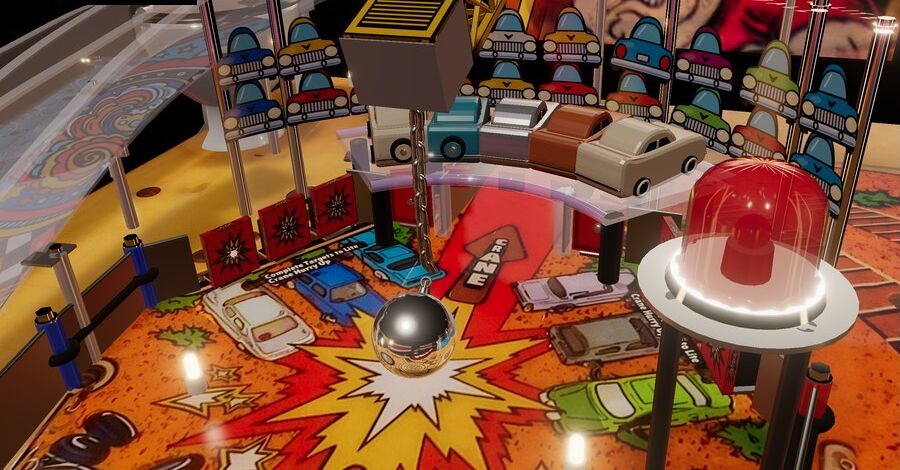
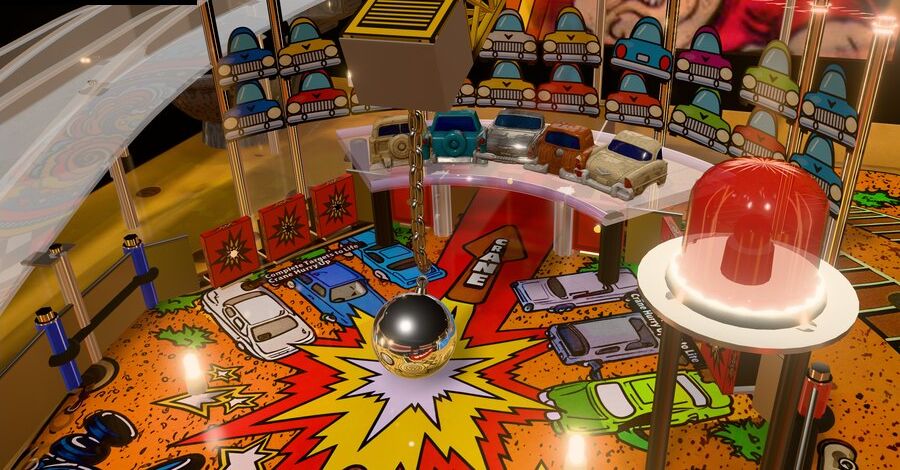
Off-the-shelf physics engines handle pinball poorly, so this one was written for this table: a 6.5° playfield, 1-1/16" steel balls, the real flipper geometry, and a wrecking ball that's a true pendulum on a chain, which the pinball can knock into the cars.
The yardstick is the factory's shot diagram in the manual. The first version got it wrong: each flipper's strong shots went straight up its own side, the right flipper could hardly make the toilet ramp, and Spike Alley was hit twice in 280 flips. The flippers were recalibrated, depending on where the ball leaves the bat, and the alley mouth corrected, until every major shot can be made from both flippers.
Then thousands of simulated balls: soak tests that look for any ball escaping or getting stuck, 300 balls dropped with the flippers switched off to check that neither outlane is favoured, robot players running full games, and fresh testers hunting for anything that felt wrong.
| Shot | Left flipper | Right flipper |
|---|---|---|
| Toilet ramp | 35 ms | 30 ms |
| Bus ramp | 55 ms | 35 ms |
| Crane (up) | 50 ms | 25 ms |
| Spike Alley | 45-50 ms | 25 ms |
| Sewer | 60 ms | 65 ms |
How long you have to make each shot from a cradled ball. Before the calibration, the right flipper's window for the toilet ramp was close to zero.
Chapter 05
The art: from 30 to 400 pixels per inch
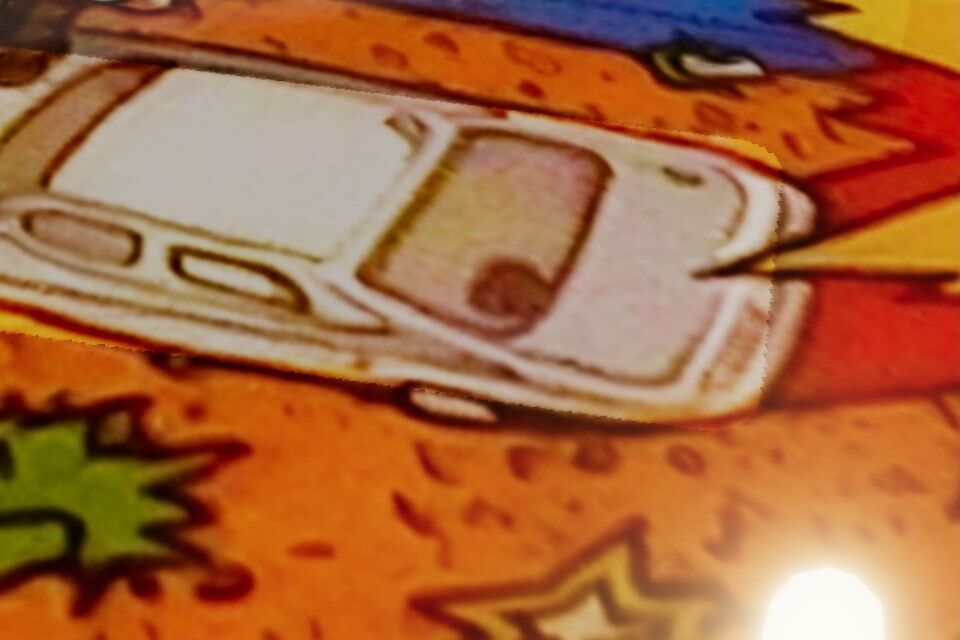
There's no high-resolution scan of a Junk Yard playfield in public. The only clean photo of a stripped playfield is 876 × 1320 pixels: about 30 pixels per inch.
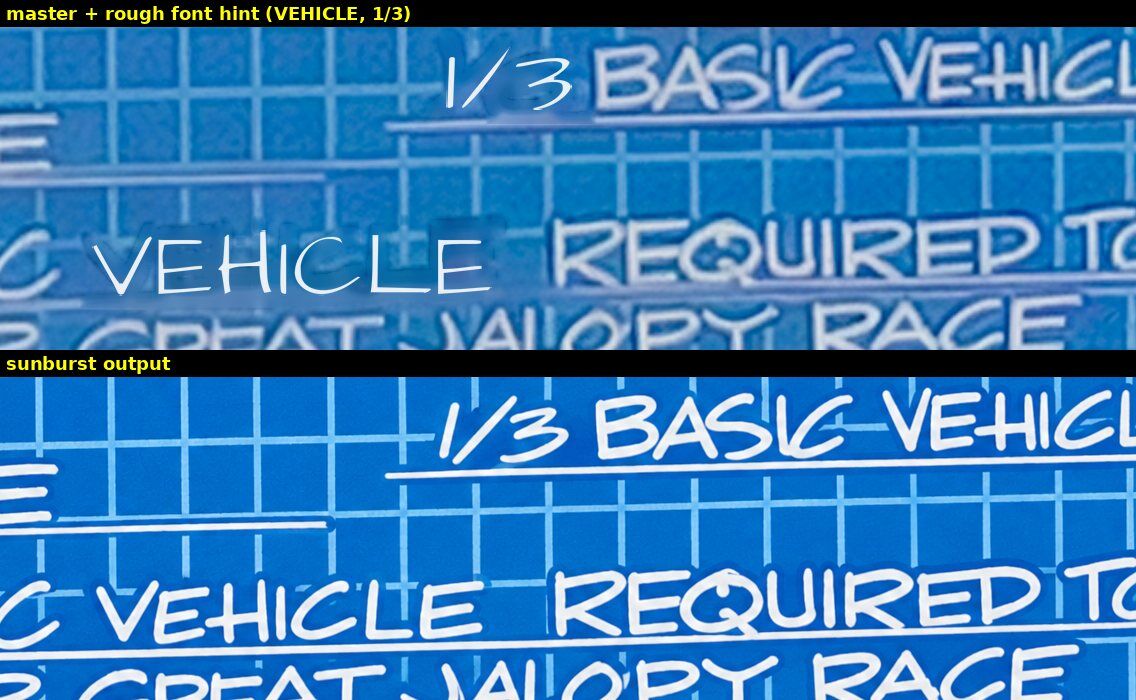
The first playfield came from that photo: straightened onto the official scan to within 0.03 inch, cleaned of posts and screws, upscaled to 160 pixels per inch, the photographer's glare modelled and taken out, and the lettering repaired where the upscale garbled it. All 61 lamp inserts were traced by hand, so each lights exactly where its bulb shines through.
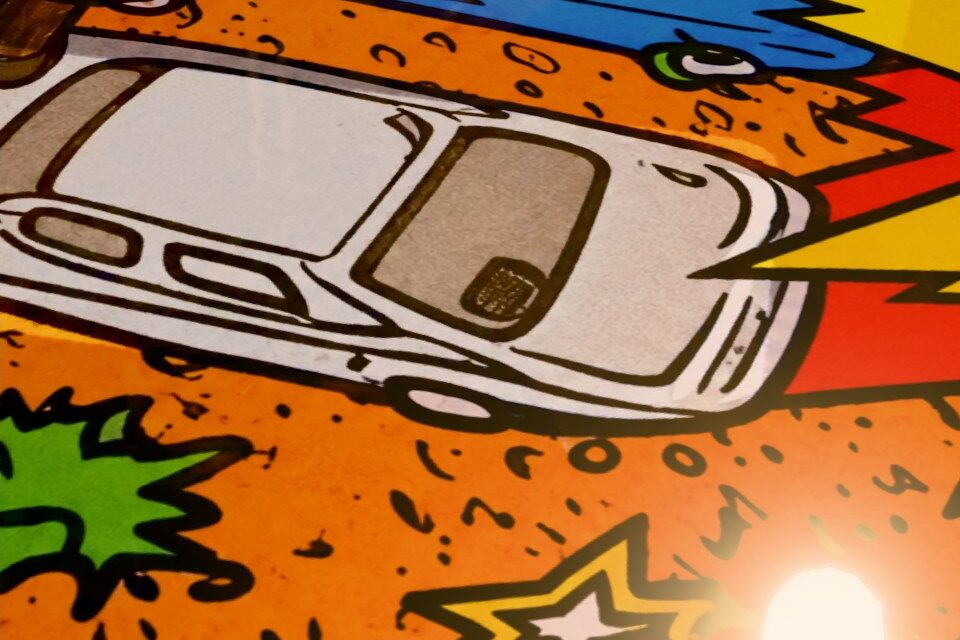
The remaster redrew the whole playfield in 50 overlapping tiles, into one master of 8,100 × 18,600 pixels: 400 per inch, in the flat, black-outlined screen-print style of the original. Nothing was allowed to move, because the lamps and the physics are aligned to the art:
- printed lines sit within 0.005 inch of the original typically, and within 0.024 inch for nine in ten;
- every lamp insert is within 0.007 inch of its outline;
- all 42 blocks of lettering were checked word by word against the photos, the manual's lamp list and the credits decal; 19 were wrong and fixed, and 0 wrong words remain (one part number is hidden in every photo and can't be checked);
- the seams between tiles are invisible at full size.
The game shows it at 160 pixels per inch on High and 256 on Ultra; the full 400 ppi master is kept for the explorer. The backglass and the cabinet art were redrawn the same way, from photos of real machines.
It's a remaster, not a restoration: the photos have 30 to 50 pixels per inch, so the finest detail is newly drawn in the original's style.


Chapter 06
Light, glass and shadow
A pinball machine is a box of small lights under a sheet of lacquer. The renderer was rebuilt around that:
- Every general-illumination bulb throws its own pool of warm light on the playfield, on the same lighting strings as the real machine, so when the program dims a string, those pools go dark.
- Colours stay the art's colours: the tone mapping keeps the printed reds and blues instead of pushing them to orange.
- Clean edges: wire ramps, posts and flipper outlines are anti-aliased on every level, and insert edges stay smooth up close.
- Ultra adds soft shadows that are sharp at the base of a post and soft under a ramp, reflections of the ball and the toys in the playfield's clear-coat, and the 256 ppi playfield, streamed in while you play.
High stays within 10% of the first version's graphics memory and uses fewer draw calls, so the upgrade costs laptops almost nothing.
Chapter 07
The toys, matched to photographs
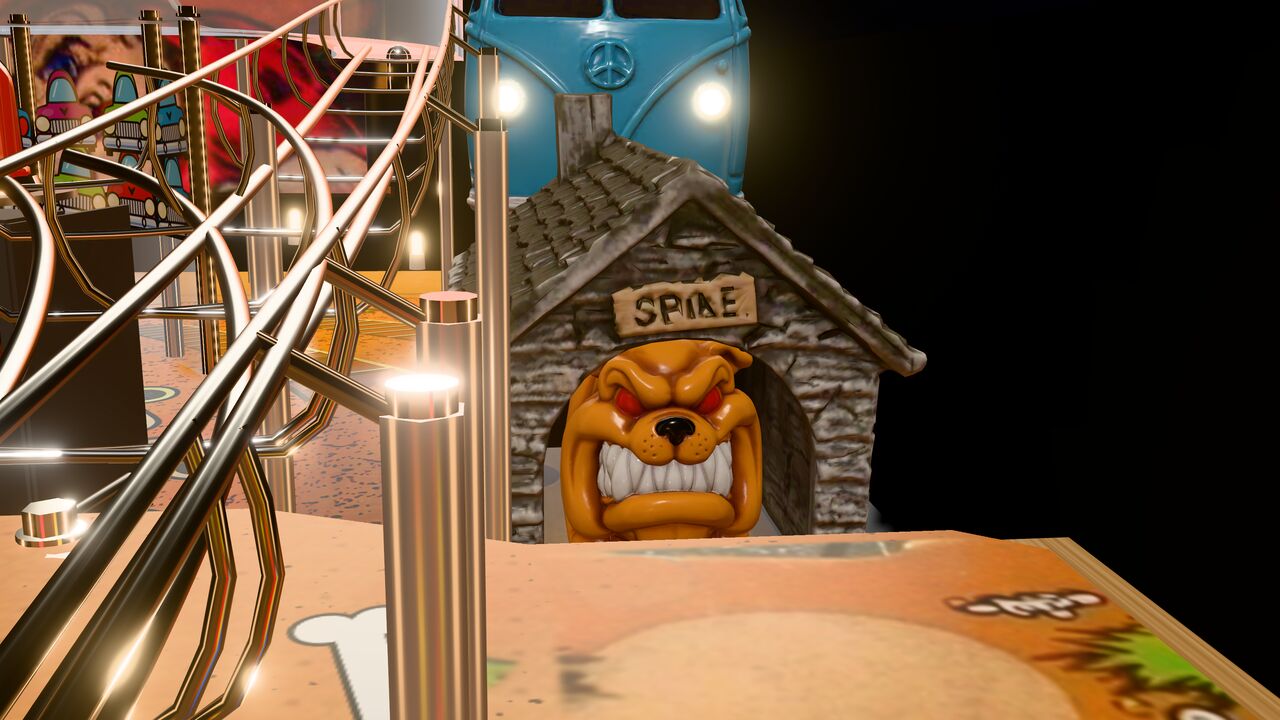
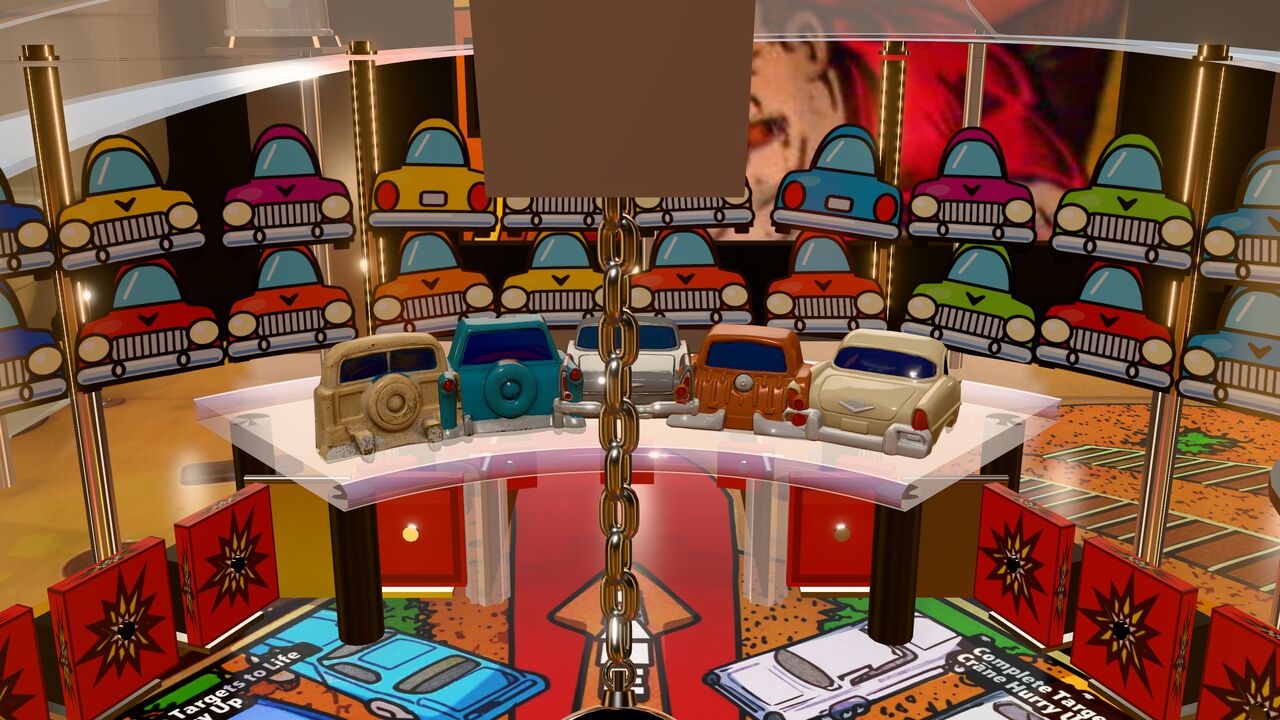
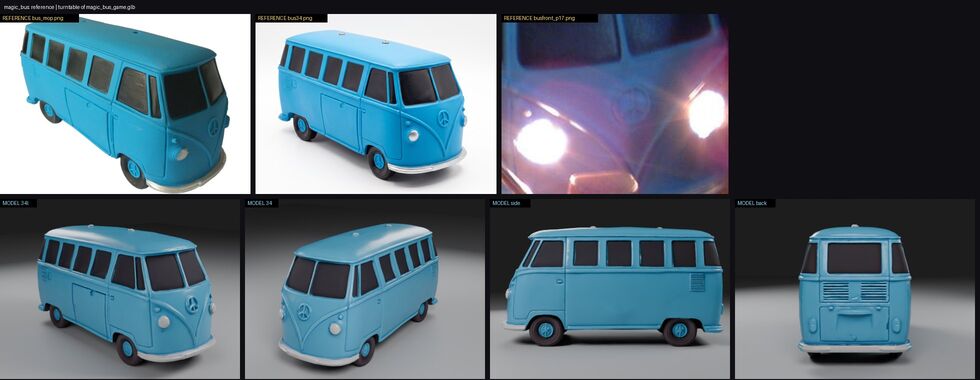
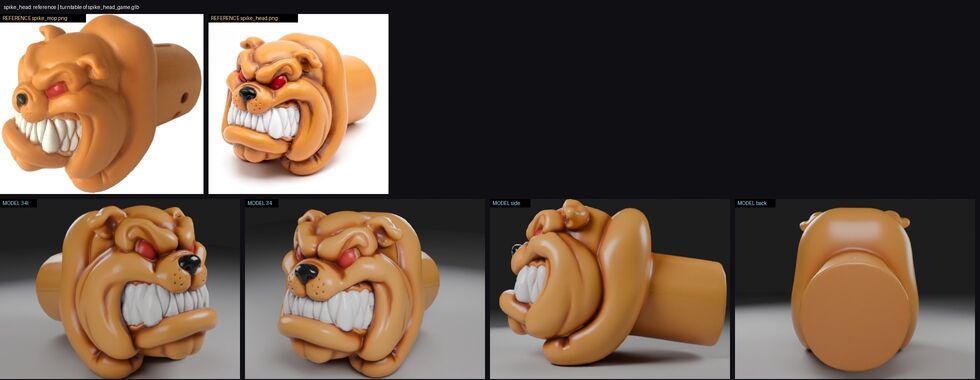
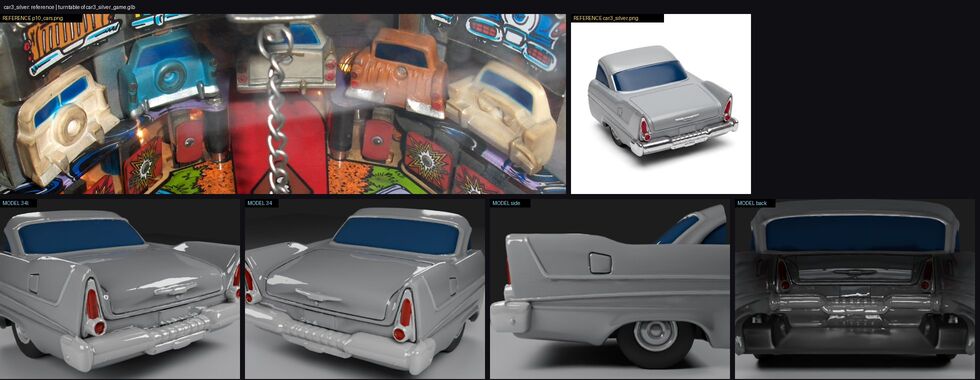
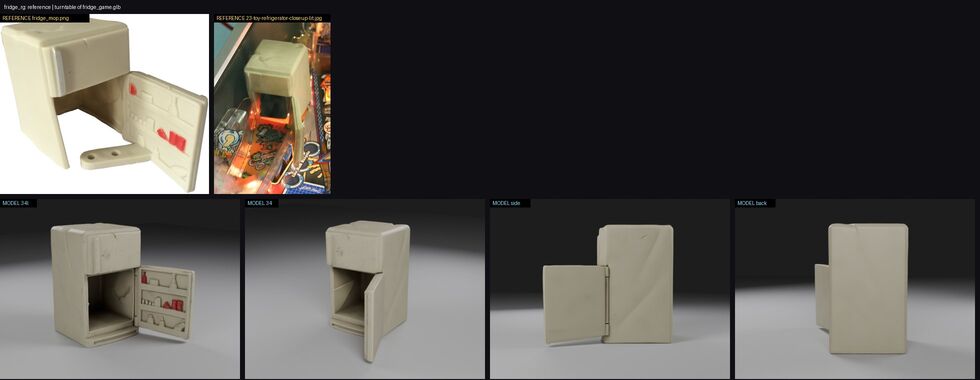
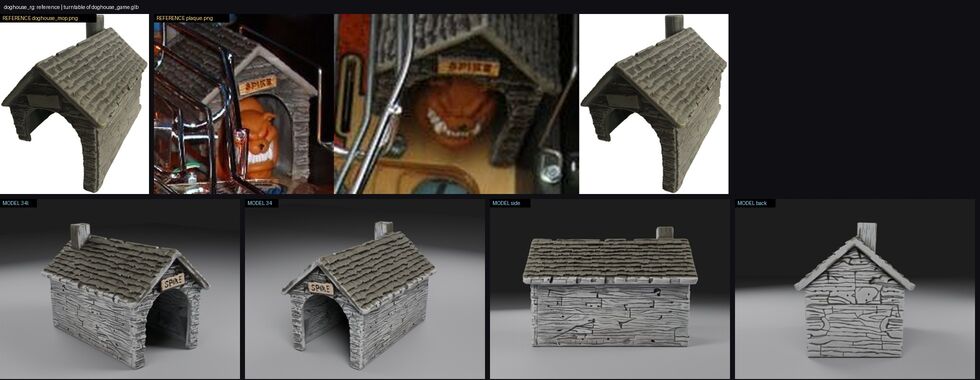
The first toys were built from simple shapes in code. Now ten toys are rebuilt from photographs: the five car targets, the toilet, the fridge, Spike, his doghouse and the Magic Bus. The best references turned out to be replacement-part product photos (clean, from several angles, in the real colours and wear), checked against the photos of machines on location.
Each one is turned into a 3-D model, scaled to the measured inches, and reviewed next to its references from four sides. The photos corrected us more than once:
- the car targets are not whole cars but rear-end plaques, about 1.1 inch wide;
- Spike is a head on a neck that lunges out of the door, not a whole dog;
- the Magic Bus has a peace sign on its nose, not a VW badge, and its headlights are lit;
- the toilet and fridge are cream, not white, and the doghouse roof is darker than its walls.
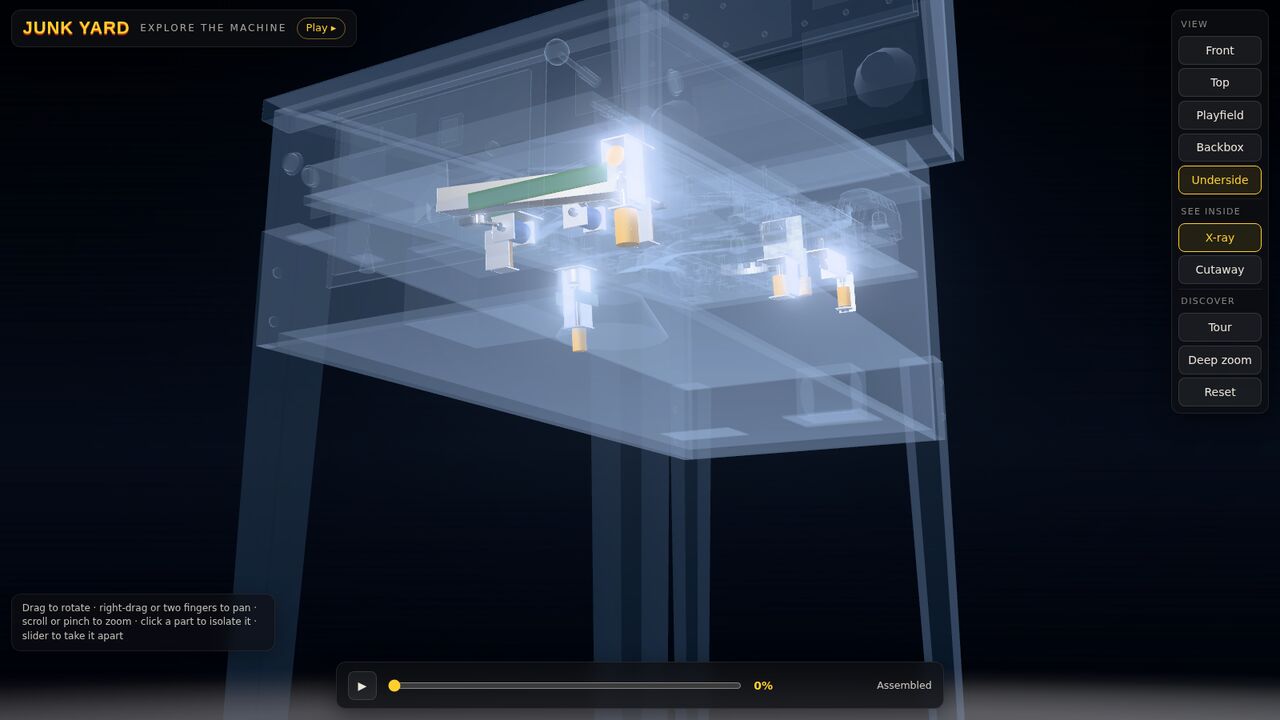
Parts the ball touches are a different job. Ramps and wire rails are built exactly along the physics paths, and posts and flippers on the physics outlines, so the ball rolls where it looks like it rolls. The whole cabinet, legs, backbox and coin door were modelled from the photos with the redrawn art. The mechanisms under the playfield (the flipper and sling coils, the ball trough, the crane drive, the three-ball popper, the dog mechanism, the fork lifter and the bus post) were modelled from the manual's exploded drawings, each coil labelled with its part number, and they work in the 3-D explorer.
The honest caveat: no photo shows the back of the bus or the far side of every toy, so those sides are plausible rather than verified.
Chapter 08
How close is it?
An honest scorecard. Fans will know anyway.
Some things are the original, byte for byte. Some are recreated as closely as the evidence allows. And one thing can't be checked from here at all: we have never put this table next to a real machine.
| Part of the machine | How close |
|---|---|
| The program: rules, scoring, display animations | Identical the 1996 ROM runs the game |
| Sounds: speech, music, effects | Identical straight from the emulated sound board |
| Wiring: switches, lamps, coils | Identical numbering confirmed by the ROM's own tests |
| Layout: toys, lanes, ramps, posts | Matched to the factory scan within about ±0.3 inch |
| Playfield art | Recreated lines within 0.005 inch, 0 wrong words; the finest detail is redrawn in the original style |
| Toys | Recreated ten toys matched to photos from four sides; the sides no photo shows are plausible, not verified |
| Physics feel | Recreated calibrated to the factory shot diagram; not measured against a real machine |
Chapter 09
How it came together
It started with the research and a first version built on it: our own rules, art and sound. Then three experiments: could the original program run in a browser, could the playfield be redrawn without moving a line, could toys be rebuilt from photos? All three worked, and the rebuild that followed is what you can play and explore now.
Last came testing: fresh testers who had never seen the project played it, read every page and checked every fact against the sources.
The research
Every photo, the manual, the patent and the rulesheets in one dossier; the layout measured in inches.
A first version
Our own physics, rules, display art and sound, to prove the table plays.
Three experiments
The original ROM in a browser, a redrawn playfield tile, toys from photos.
The original machine
The 1996 program drives the table: flippers, coils, lamps, display and sound.
The remastered look
The 400 ppi playfield, the redrawn backglass and cabinet art, a new renderer and Ultra.
Every toy and the cabinet
Ten toys from photographs, and the whole machine around them.
The explorer
The machine in 3-D: a 29-stop tour, explode, x-ray, the mechanisms working, deep zoom.
This site and testing
Fresh eyes on every page, every fact and every link.